Assad
The Hanging GirlAssad is Carl Mørck’s close investigative partner, a perceptive and resourceful presence whose humor persists through the team’s most demanding inquiries. In the investigation of Alberte Goldschmid’s death, he helps uncover a concealed photographic clue and retrace the likely collision route; later, when Carl and Assad are trapped in a deadly electrical setup, Assad’s quick understanding of the mechanism saves Carl at the cost of a severe injury to his left hand. His recurring aliases, including Curly and Said, also leave a small but persistent question around his identity.
Identity and Presence
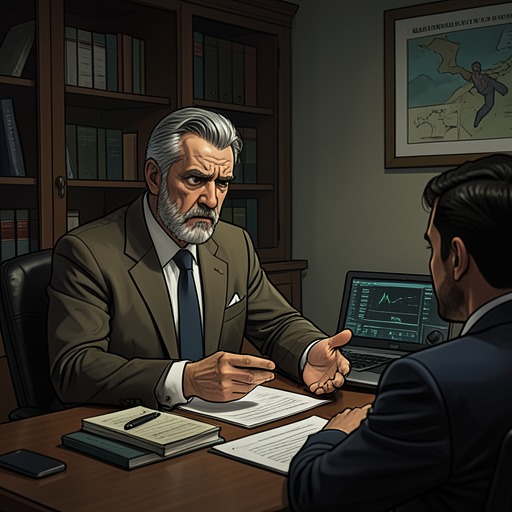
On the morning of April 29, 2014, Carl wakes to find Assad beside him, his white overalls transformed by paint into something like a yellow carnival costume. The contrast between the overalls he began the day wearing and his paint-spattered appearance gives his first impression a physical comedy that suits his easy, smiling manner. Carl complains that Assad has interrupted a complicated train of thought; Assad answers with an apology whose smile and bright eyes seem to carry a hint of irony. Their exchange establishes a familiar rhythm: Carl’s irritation meets Assad’s lightness rather than a competing display of temper.
That humor is not confined to private banter. When the investigators visit Bjarke Habersaat, Assad identifies the strong smell in the house as skunk and distinguishes it from hash. His observation is precise and almost matter-of-fact, while Carl’s response dismisses the distinction as no improvement on the surrounding decay. The moment makes Assad’s attention to immediate detail part of his character, even when the detail is unpleasant and the people around him are uncomfortable.
Investigative Partnership
Assad’s contributions to the Alberte inquiry combine physical attentiveness with a willingness to test the assumptions behind the evidence. While the investigators examine a photocopy, he realizes that something is attached to its reverse. Habersaat had apparently expected them to take the enlargement with them, and the concealed material proves to be a photo-album page bearing four photographs. The discovery turns a seemingly ordinary copy into a lead: Assad notices the hidden layer, and the pair recover the photographs that had been kept out of view.
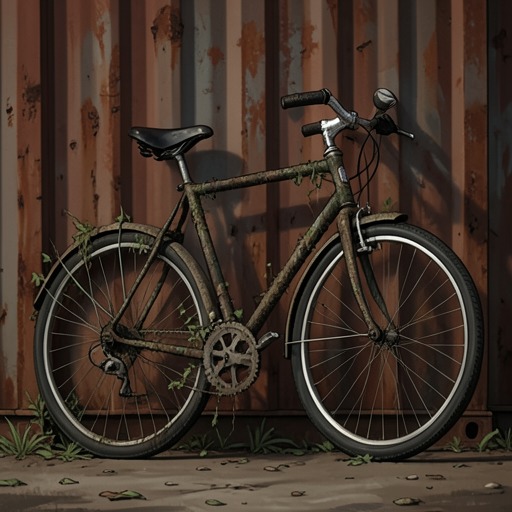
The investigation also takes them back to the suspected collision route on Bornholm. On May 2, Carl proposes checking a tree near Skørrebrovejen, not far from Aakirkeby, and Assad suggests approaching by the back road so they can follow the route taken by the driver. As they examine the map, Carl corrects Assad’s choice of word, but accepts the route he traces. At the trees, Assad points out the field track and the place where the bicycle had been found among the undergrowth. The distance it had travelled prompts them to question whether the vehicle’s impact could have thrown it so far. Assad then focuses the question on both the car and the bicycle, helping turn the physical arrangement of the scene into a problem that demands explanation.
The case had not been treated as a possible premeditated murder by the earlier investigation. The papers given to Carl were out of date, and the police in Rønne had settled on a hit-and-run theory without identifying either the vehicle or its driver. Habersaat’s persistence had pushed the inquiry in a more specific direction, but Carl recognizes that his certainty did not itself establish what had happened. Assad accompanies Carl as they revisit the scene and the evidence, part of the partnership through which old conclusions are examined rather than simply accepted.
Their work extends beyond the collision evidence. When Rose assigns Assad to speak with June Habersaat’s sister in a nearby nursing home, she explains that June may have confided in her. Rose also points out that Assad may have contributed to the likelihood that June herself will tell them little about her husband’s inquiries. Assad takes the criticism without argument, attending instead to the precarious task of pouring sugar into his coffee. Rose’s bluntness and his unruffled acceptance show a working relationship in which he can be held responsible without the exchange becoming a rupture.
Later, Carl asks Rose to check a short list and directs Assad to help establish how many people called Frank fit the relevant years. The available records do not provide a complete year-by-year count before 1989, so the investigation has to work with less precise totals organized by decade. Assad’s part in the inquiry is not limited to a single dramatic discovery: he also helps pursue the patient, sometimes incomplete work of narrowing down a name.
Humor, Knowledge, and Uncertainty
Assad’s talk with Carl and Hardy shows how he uses humor to keep a stalled investigation moving. Carl describes a story at an impasse and jokes that it needs a unicorn or a flying elephant to get started again. Assad answers with a saying about riding a camel in the fifth way. Hardy offers his own interpretation, while Carl briefly loses the thread. The exchange is comic, but it also gives Assad a way to contribute when the investigators have reached a deadlock: he supplies a different image rather than pretending the evidence is already clear.
His conversation with a professor offers another glimpse of his interests and his willingness to participate in an explanation. As the professor describes the zodiac and the sun’s annual passage around its circle, Assad interjects that he is a Leo and that his name means lion. The professor then explains the Earth’s daily rotation through sunrise, zenith, sunset, and nadir. Carl reduces those terms to morning, noon, evening, and midnight. Assad’s remark places him inside the discussion rather than at its edge, while the scene’s contrast between formal explanation and plain-language wit echoes the easy exchanges that characterize his partnership with Carl.
The name Said, unlike the playful camel saying, remains unresolved. After a hypnotist has helped Carl, Carl asks why the hypnotist once called Assad Said. The old man admits that he overstepped his authority and explains that Said was the name Assad used during a séance; he says he never learned a surname. Later, an interpreter’s suggested translation of a message again addresses someone as Said, prompting the investigators to notice the recurrence. The evidence establishes that the name was used in that separate setting, but does not settle what it means for Assad’s identity. The scene thus turns a brief alias into a question the investigation cannot immediately close.
Loyalty and Injury
Assad’s importance to Carl is made plain in a quiet moment around a funeral. As Carl considers who will be there for him, he looks at Assad, who is innocently trying to sing along, and pats his arm. Assad stops and asks whether Carl has something to say. Carl smiles, feeling that he has already said all he can. The gesture is understated: their closeness appears not as a speech about friendship but as a touch, an awkward question, and Carl’s confidence that Assad will be present.
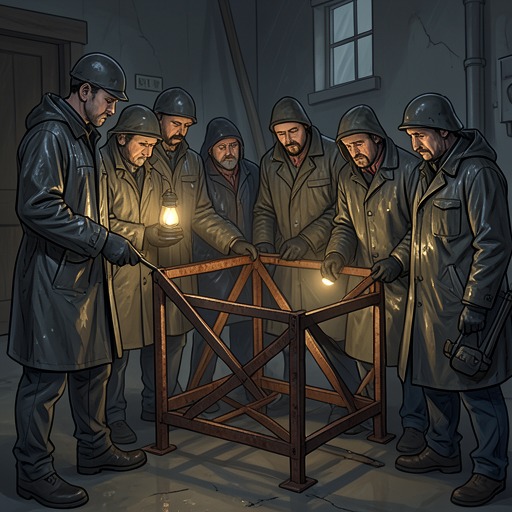
That confidence is tested when the two men are caught in an electrical trap. Carl, struggling to move and speak, asks what is happening. Assad identifies a ground connection in the wall. A faint trace of smoke rises from his hand, and he explains that the current is not travelling any farther. Carl sees that Assad’s finger is turning brown and its tip darker. The current has accumulated from numerous solar cells and reached the metal wall through a cable wound around Assad’s thumb. Assad is taking the electrical burden onto his own hand so that it does not continue through them both.
The immediate consequence is that Carl survives. After the ordeal, he can barely swallow water, his head still moves unsteadily, and his ankle and lungs hurt; within ten minutes he is already feeling better. He knows that Assad saved him, and his attention turns at once to whether Assad can also be saved. The reversal is stark: the partner who had so often steadied an investigation with a remark or a clue has acted directly to keep Carl alive.
Information from Kalmar Hospital makes the cost unmistakable. Assad needs to have his left thumb amputated, but he refuses. He says that if it has to come off, he will be the one to do it. Carl stares at the badly charred hand and asks whether Assad is sure. The outcome of the injury is not resolved in this moment; what is clear is Assad’s refusal to surrender the decision to others. His quick reading of the ground connection has saved Carl, but the last account of the event leaves him facing a permanent loss and insisting on his own agency in what follows.